How AI Is Changing the Lighting Design Industry in 2026
Discover how AI is transforming the lighting design industry in 2026, from automated mockups and smart pricing to AI-driven sales training for contractors.

Artificial intelligence (AI) is fundamentally reshaping the lighting design industry in 2026, moving from a futuristic concept to a practical tool that automates complex tasks, optimizes project financials, and sharpens sales strategies. For professional lighting contractors, AI-powered software is no longer a novelty but a critical component for achieving greater efficiency, accuracy, and profitability, offering a decisive competitive advantage to those who adopt it early.
How is AI Revolutionizing Lighting Design Mockups?
The creation of design mockups has historically been a major bottleneck in the sales process for lighting contractors. It was a craft that demanded artistic skill, technical knowledge, and a significant time investment. The advent of AI has completely dismantled this old paradigm, introducing a new era of speed, realism, and client engagement.
From Hours to Seconds: The Unbelievable Speed of AI Mockups
Traditionally, creating a compelling lighting mockup involved a painstaking manual process. A contractor would need to use sophisticated desktop software like Adobe Photoshop or specialized CAD programs. This involved manually placing each light fixture, adjusting for brightness and color, and attempting to simulate shadows and beam spreads—a process that could take hours, or even days, for a single design. Revisions based on client feedback meant starting this laborious process all over again.
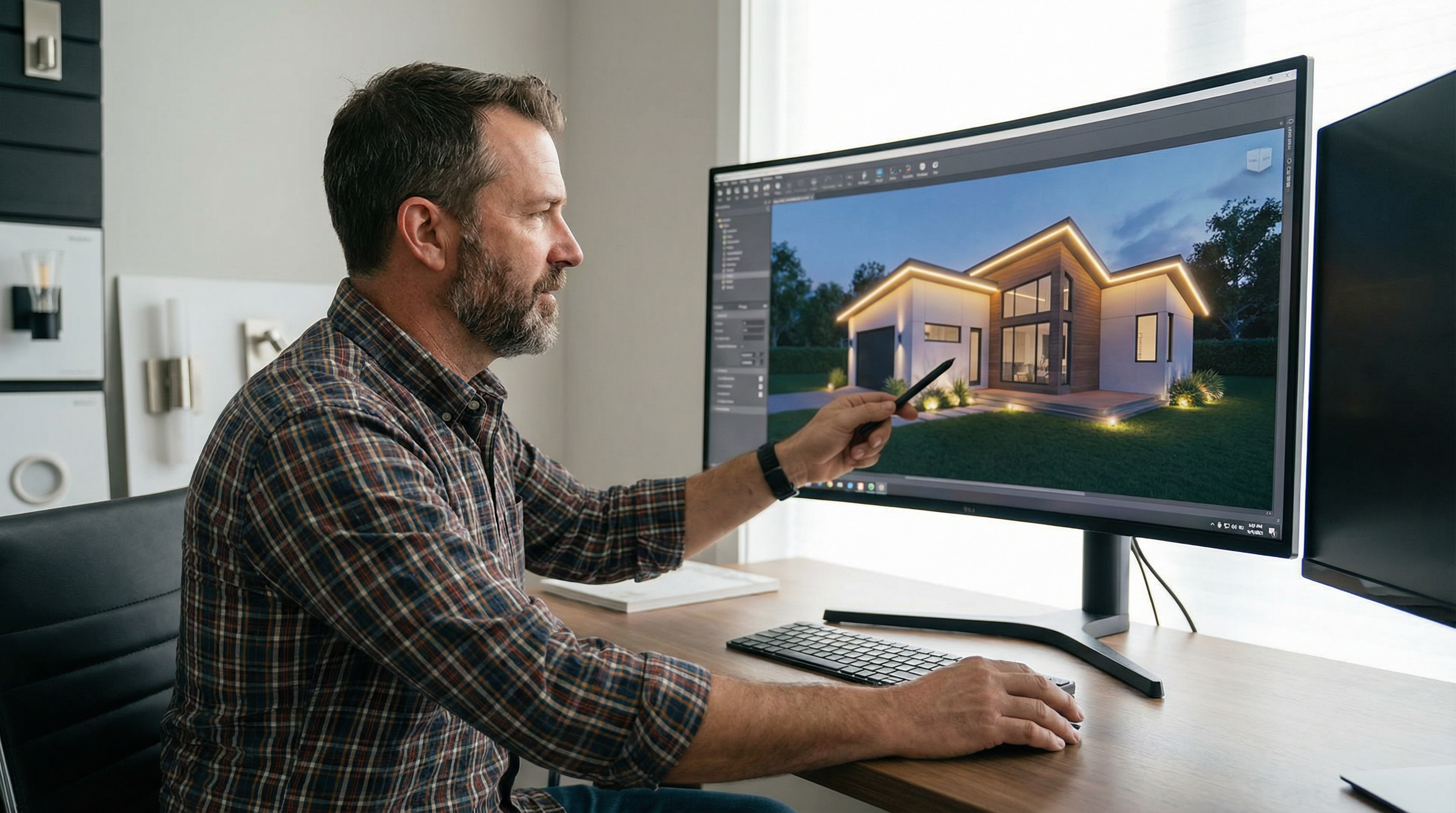
In 2026, AI has turned this multi-hour ordeal into a task that takes mere seconds. Modern AI platforms allow a contractor to simply upload a photograph of a client's property—be it a home, a commercial building, or a landscape. The AI analyzes the image, identifies architectural features, and automatically generates a stunning, photorealistic lighting design. This incredible speed doesn't just save time; it transforms the sales conversation. Contractors can now generate multiple design optionslive with the client, making adjustments on the fly and fostering a collaborative and exciting sales experience.
The Realism and Accuracy of AI-Generated Visuals
Early iterations of design software often produced visuals that looked artificial or flat. They gave a general idea but lacked the nuance to truly sell a vision. AI-powered mockup generators have leaped past this limitation. They can realistically simulate a vast array of lighting variables:
- Light Temperature: Show a client the difference between a warm, inviting 2700K and a crisp, modern 4000K on their own home.
- Beam Angles: Accurately depict how a narrow spotlight will highlight a specific architectural feature versus how a wide wash light will illuminate a broad wall.
- Fixture Types: Visualize the distinct effects of uplighting, downlighting, string lights, and pathway lights, all within the same design.
This level of realism is crucial for managing client expectations. When a client can see an accurate representation of the final product, there are no surprises upon installation. This leads to higher customer satisfaction and stronger referrals. For contractors, it means closing deals with confidence, knowing that the vision they sold is the one they can deliver.
Gaining a Competitive Edge with Instant Mockups
In a competitive market, speed is a weapon. The ability to provide a professional, beautiful mockup almost instantly is a massive differentiator. While a competitor is still scheduling a follow-up meeting to present their manually created design, an AI-equipped contractor has already walked the client through multiple options and is moving towards a signed contract.
Platforms like IgnitelyAI are at the forefront of this revolution, providing a powerful yet easy-to-use mockup generator that is purpose-built for the lighting industry. By leveraging such tools, contractors can dramatically shorten their sales cycle, increase their close rate, and handle a higher volume of leads without a corresponding increase in administrative overhead. It allows them to focus their valuable time on building relationships and executing high-quality installations, rather than being bogged down by design work.
What is Smart Pricing and AI-Powered Material Estimation?
Quoting a lighting project accurately is a high-stakes balancing act. Price it too high, and you lose the bid. Price it too low, and you erase your profit margin or even lose money. AI is bringing scientific precision to this art, eliminating guesswork and ensuring that every project is priced for profitability.
Eliminating Guesswork with Data-Driven Quoting
Manual quoting is fraught with potential errors. It often relies on rules of thumb, incomplete data, and a contractor's "gut feeling." AI replaces this with a data-driven analytical engine. An AI pricing model can analyze thousands of data points to generate a quote, including:
- Historical Project Data: Your own past projects are a goldmine of information. AI can analyze them to see how long similar jobs took and what their final costs were.
- Real-Time Material Costs: AI can integrate with supplier databases to pull the most current pricing for fixtures, wiring, transformers, and other components.
- Labor Rates and Complexity: The system can factor in your team's labor costs and adjust for project complexity, such as difficult-to-access installation points or complex wiring runs.
- Geographic Modifiers: Costs can vary significantly by region. AI can adjust pricing based on local market conditions.
This comprehensive approach results in a quote that is not only accurate but also defensible. You can confidently explain to a client exactly how you arrived at the price, building trust and transparency.
Optimizing Your Bill of Materials with AI
Once a design is approved, creating the bill of materials is the next critical step. A manual takeoff from plans is tedious and prone to human error—forgetting a few connectors or underestimating the length of a wire run can lead to last-minute scrambles and budget overruns. AI automates and optimizes this entire process. Based on the approved mockup, the AI can:
- Generate a complete and accurate list of every single component needed for the job.
- Calculate the precise amount of wiring required, minimizing costly waste.
- Suggest cost-saving alternatives, such as a different fixture model that meets the design specifications but is available at a lower price.
- Ensure compatibility between all components, flagging potential issues like a transformer being overloaded.
This level of automation ensures that your installation team arrives on-site with everything they need to complete the job efficiently, preventing costly delays and return trips to the supplier.
| AI Application | Traditional Method | AI-Powered Advantage |
|---|---|---|
| Mockup Generation | Manual design using complex software (hours/days) | Automated, near-instantaneous mockups from a photo (seconds/minutes) |
| Pricing | Manual calculation based on rough estimates and past jobs | Data-driven, highly accurate quotes based on real-time data and historical analysis |
| Material Estimation | Manual takeoff from plans, prone to human error | Automated, optimized material lists with waste reduction and cost-saving suggestions |
| Sales Training | Role-playing with managers, shadowing senior staff | AI-powered simulations with personalized, instant feedback and performance tracking |
Can AI Really Train My Sales Team?
The idea of using AI for sales training might seem impersonal, but in reality, it offers a highly personalized, scalable, and effective way to onboard new salespeople and upskill your entire team. It provides a safe and repeatable environment for them to hone their skills before they engage with actual clients.
Realistic Sales Simulations
AI can create interactive role-playing scenarios that are far more dynamic than static scripts. A new salesperson can practice their pitch with an AI-generated "client" that has a specific personality and set of objections. For example:
- The "Price-Shopper": An AI persona that consistently pushes back on price, allowing the salesperson to practice value-based selling and objection handling.
- The "Skeptical Engineer": A persona that asks detailed technical questions, forcing the salesperson to learn the product specifications inside and out.
- The "Indecisive Homeowner": An AI that expresses uncertainty, requiring the salesperson to build confidence and guide the decision-making process.
These simulations can be practiced anytime, anywhere, allowing for consistent reinforcement of best practices.
Personalized Feedback and Performance Analytics
This is where AI sales training truly shines. The system doesn't just provide a practice environment; it acts as a personal coach. The AI can record and analyze the salesperson's conversation, providing instant, objective feedback:
"You spoke for 80% of the conversation. Try asking more open-ended questions to engage the client."
"When the client mentioned a competitor, you didn't effectively differentiate our product's unique features."
"You missed an opportunity to mention our 5-star reviews and warranty when the client expressed concerns about reliability."
This feedback is tracked over time, creating a performance dashboard for both the salesperson and their manager to identify strengths and weaknesses and tailor future training.
What Does the Future Hold for AI in the Lighting Industry?
The tools available in 2026 are already transformative, but they are just the beginning. The future of AI in lighting design points towards a more connected, predictive, and personalized world.
Predictive Maintenance and Smart Systems
Looking beyond the initial installation, AI will play a crucial role in the long-term service and maintenance of lighting systems. By monitoring usage patterns and performance data, an AI can predict when a specific fixture is likely to fail and automatically schedule a maintenance visit before the client even notices a problem. This proactive approach to service can become a significant revenue stream for contractors, moving them from a one-time installation model to a long-term relationship with recurring revenue. For more on this, see our guide on the benefits of smart lighting systems.
Hyper-Personalization
Future AI systems will learn the individual preferences and routines of the people using the space. The lighting in a home could automatically adjust throughout the day to support a person's circadian rhythm, brighten for tasks, and dim for relaxation—all without manual input. In a commercial setting, it could adjust based on occupancy, time of day, and even the amount of natural daylight available, leading to significant energy savings.
By embracing the AI tools available today, lighting contractors are not just improving their current operations; they are positioning themselves to be leaders in the smarter, more connected future of the lighting industry. The time to adapt is now.
Frequently Asked Questions
What is AI lighting design?
AI lighting design uses artificial intelligence software to automate and enhance the process of creating lighting plans. This includes generating mockups, optimizing fixture placement, and calculating project costs.
How can AI help a lighting business?
AI can help a lighting business by dramatically speeding up the sales process with instant mockups, ensuring profitability with data-driven pricing, reducing errors with automated material lists, and improving sales team performance through AI-powered training.
Is AI going to replace lighting designers?
No, AI is a tool to augment, not replace, the skills of a professional lighting designer or contractor. AI handles repetitive and data-intensive tasks, freeing up professionals to focus on creativity, client relationships, and complex problem-solving that requires human experience.
What is the best AI software for lighting contractors?
The best AI software is one that is specifically built for the needs of the lighting industry, like IgnitelyAI. These platforms focus on the unique workflows of lighting professionals, offering tools like instant mockup generation from a photo, accurate material estimation, and smart pricing.
How does an AI mockup generator work?
An AI mockup generator analyzes a photo of a property, identifies its architectural features, and then automatically places light fixtures to create a photorealistic rendering. This allows contractors to show clients exactly what the finished project will look like in seconds.
Ready to Transform Your Lighting Business?
Join thousands of lighting contractors using IgnitelyAI to create stunning mockups, close more deals, and grow their business.
Start Your Free Trial