Christmas Light Calculator: Materials, Footage & Cost Estimator
A professional guide for Christmas light contractors on how to accurately calculate materials, footage, and costs for any installation job.
A Christmas light calculator helps professional installers accurately estimate the total materials, linear footage, and project cost by using specific formulas for light strands, clips, and power requirements.
For professional Christmas light installers, accuracy is everything. Underestimate a job, and you leave money on the table or, worse, run out of materials mid-installation. Overestimate, and you risk losing the bid to a competitor. This is where a reliable Christmas light calculator becomes the most valuable tool in your arsenal. It’s not just about counting bulbs; it’s about a systematic approach to quoting that ensures profitability and customer satisfaction.
This guide provides the real formulas and industry knowledge you need to move beyond guesswork and create precise, competitive bids. We'll break down how to calculate everything from the exact number of light strands to the right-sized extension cords, ensuring your projects are both beautiful and profitable.
How Do You Calculate Christmas Lights for a House?
Calculating the Christmas lights needed for a house involves measuring all rooflines, windows, and doorways to be decorated, and then applying specific formulas to determine the required number of light strands and clips. You must also account for power sources and extension cord lengths to ensure a safe and functional installation.
Step 1: Measure Everything
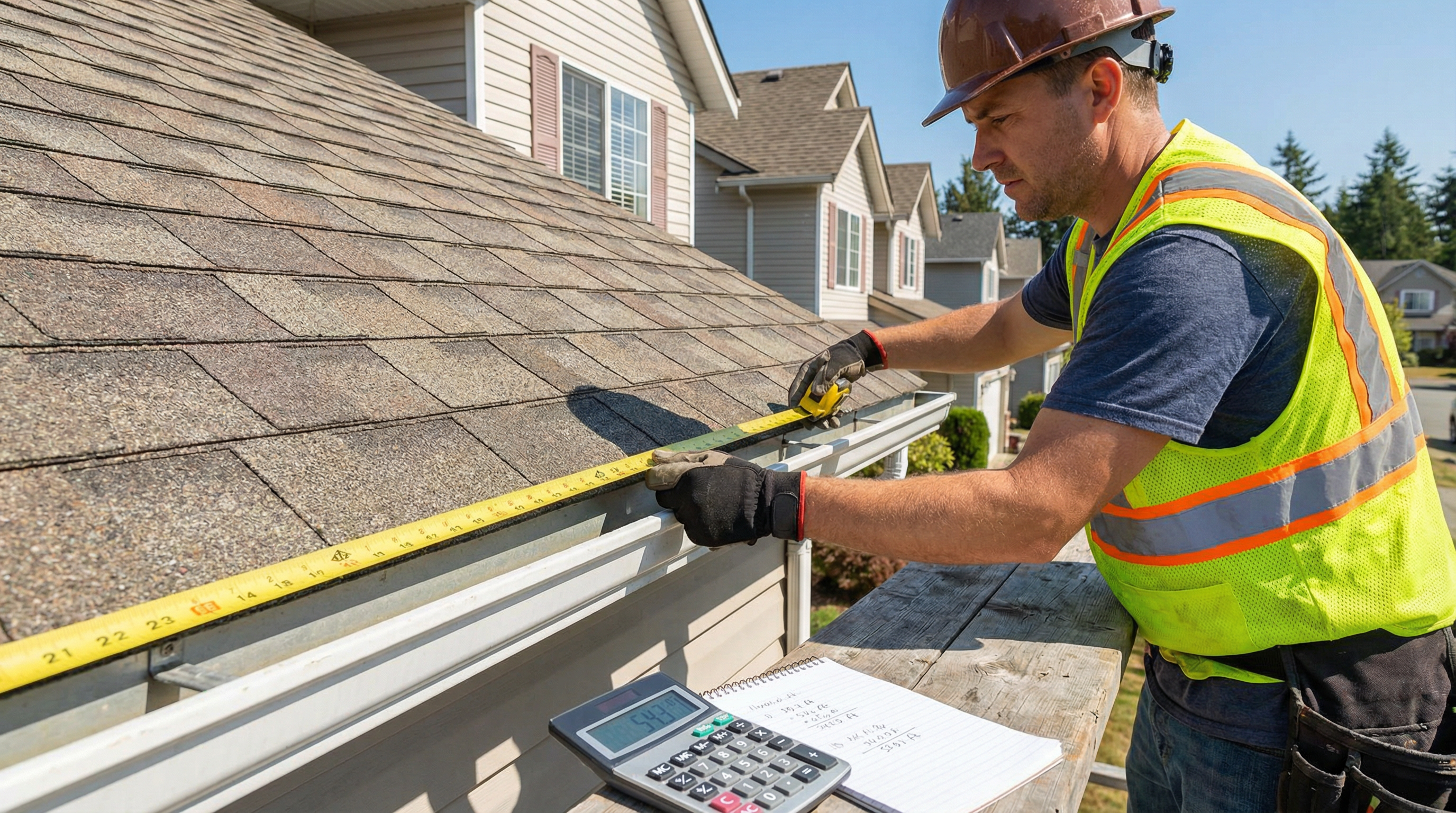
Accurate measurements are the foundation of any professional lighting quote. During your initial site visit, don’t just eyeball it. Use a measuring wheel or a laser measure to get precise linear footage for every surface the client wants decorated.
- Rooflines: Measure all fascia, ridges, and dormers. Don't forget to account for peaks and gables.
- Windows and Doors: Measure the perimeter of each window and door frame.
- Trees and Shrubbery: For wrapping trunks and branches, measure the height and circumference. For canopy or net lighting, measure the diameter of the foliage.
- Pathways and Driveways: Measure the length of any walkways or driveways to be lined with stake lights.
Pro Tip: Use a tool like Google Maps or a satellite imagery service to get preliminary measurements before your site visit. This allows you to come prepared with a rough estimate, which you can then refine on-site. However, always rely on your own physical measurements for the final quote.
What is the Formula for Calculating Christmas Lights?
The core of a Christmas light calculation is a set of formulas that translate your linear footage measurements into material quantities. These formulas are essential for building an accurate quote.
Calculating Light Strands
For C7 or C9 bulb strands, the calculation is straightforward:
Number of Strands = Total Linear Feet / Length of One Strand
However, you must account for the fact that you can only cut custom-fit spools at the end of a run. For standard pre-made strands, you will always have some excess. It is standard practice to add a 10-15% buffer to your total linear footage to account for errors, cuts, and waste.
Adjusted Linear Feet = Total Linear Feet * 1.15
Calculating Clips
The number of clips depends on the spacing you use between each bulb. Professional installers typically use a tighter spacing for a cleaner, more uniform look.
Number of Clips = Total Linear Feet / (Clip Spacing in Inches / 12)
For example, if you are using a 12-inch spacing, you will need one clip per foot. For a 6-inch spacing, you would need two clips per foot. Always add a buffer of 10% to your clip count.
Calculating Power and Extension Cords
Power calculation is critical for safety and functionality. Overloading a circuit is a fire hazard and a rookie mistake.
- Calculate Total Amperage: First, determine the total amperage draw of your lights. You can find the amperage per bulb or per strand on the product's specifications.
Total Amps = Number of Bulbs * Amps per Bulb - Determine Circuit Capacity: Standard household circuits are either 15 or 20 amps. Never exceed 80% of the circuit’s capacity.
Safe Circuit Capacity = Circuit Amperage * 0.80 - Plan Your Runs: Based on the safe circuit capacity, plan how many strands can be connected in a single continuous run from one power source.
Maximum Strands per Run = Safe Circuit Capacity / Amps per Strand
This calculation will determine how many separate extension cords you will need to run from different outlets. When choosing extension cords, use a heavy-duty, outdoor-rated cord (12 or 14 gauge) to minimize voltage drop, especially over long distances.
How Do You Estimate the Cost of a Christmas Light Installation?
Estimating the cost involves combining your material costs with your labor costs and then adding your company’s markup for overhead and profit.
Final Price = (Total Material Cost + Total Labor Cost) * Markup
- Material Cost: Use the formulas above to get a precise count of all lights, clips, cords, and timers. Multiply these quantities by your wholesale cost. Don’t forget to factor in the 15% material buffer.
- Labor Cost: Estimate the total hours required for both installation and takedown. A good rule of thumb is to estimate 1 hour of labor for every 100-150 feet of roofline, but this can vary significantly based on the complexity of the job (e.g., steep roofs, multiple stories).
Labor Cost = (Install Hours + Takedown Hours) * Hourly Rate per Installer - Markup: Your markup covers your overhead (insurance, marketing, vehicle costs, etc.) and your desired profit margin. A typical markup in the industry is between 1.5x and 3x the total cost of materials and labor.
Quick Reference Table for Estimating
| Item | Calculation Formula | Pro Tip |
|---|---|---|
| Light Strands | (Total Linear Feet * 1.15) / Strand Length | Always round up to the next full strand. |
| Clips | (Total Linear Feet / (Spacing / 12)) * 1.10 | Use tighter 6" or 8" spacing for a premium look. |
| Power Load | Total Bulbs * Amps per Bulb | Never exceed 80% of a circuit's total amperage. |
| Labor Hours | Total Linear Feet / 125 (average) | Adjust based on roof pitch, height, and complexity. |
| Total Price | (Materials + Labor) * Markup (1.5-3.0) | Your markup is key to profitability. Don't underprice your expertise. |
Streamline Your Estimates with Technology
While these formulas are the bedrock of accurate quoting, performing these calculations manually for every job is time-consuming and prone to error. This is where modern software solutions come into play. A platform like IgnitelyAI transforms the entire process.
With IgnitelyAI’s built-in mockup generator and material estimator, you can upload a photo of the client’s property, trace the rooflines and windows, and the software automatically calculates the precise linear footage. It then instantly generates a complete material list based on your pre-set bulb spacing and strand lengths. What used to take 30 minutes of manual measuring and calculating can now be done in under 5 minutes with near-perfect accuracy. This not only saves you time but also allows you to provide clients with a professional, visual proposal on the spot, dramatically increasing your closing rate.
For more tips on running your business, check out our guide on how to price your services effectively.
Frequently Asked Questions
How many feet of Christmas lights do I need for a 2,000 sq ft house?
There is no direct correlation between square footage and the linear feet of lighting required. A 2,000 sq ft ranch-style home will have a much larger roofline perimeter than a 2,000 sq ft two-story home. Always measure the specific linear feet of the areas to be decorated.
How many C9 lights can I string together?
This depends on the wattage of the bulbs and the gauge of the wire. For traditional incandescent C9 bulbs (7 watts), you can typically only run about 100 feet on a single 15-amp circuit. With modern LED C9 bulbs (under 1 watt), you can often run 500 feet or more. Always check the manufacturer's specifications and calculate your total amperage.
What is the best spacing for C9 bulbs?
For a professional, high-end look, 12-inch or 15-inch spacing is most common. Wider spacing like 18 or 24 inches can look sparse and less impactful. Tighter spacing, like 6 or 8 inches, can be used for a dramatic, bright effect but will significantly increase material and labor costs.
How much should I charge for Christmas light installation?
Pricing varies widely by region and the scope of the project. A common pricing model is to charge a base price per foot, which includes all materials and labor. This can range from $4 to $10+ per linear foot. For a detailed breakdown, see our <a href="/blog/christmas-light-installation-pricing-guide">complete pricing guide</a>.
What's the best way to measure a roof for Christmas lights?
The safest and most accurate method is to use a combination of a measuring wheel for ground-level perimeters and a tool like Google Maps or a drone for aerial measurements of rooflines. This minimizes time spent on ladders during the quoting process.
How do I power my Christmas light display safely?
Never overload your circuits. Distribute your lights across multiple outlets and use heavy-duty, outdoor-rated extension cords. Use a GFCI (Ground Fault Circuit Interrupter) protected outlet for all outdoor decorations to prevent electrical shock.
Should I use LED or incandescent lights?
For professional contractors, LED is the only choice. They consume up to 90% less energy, are more durable, last significantly longer, and allow for much longer runs on a single circuit. The higher upfront cost is easily offset by the energy savings and reduced maintenance.
Ready to Transform Your Lighting Business?
Join thousands of lighting contractors using IgnitelyAI to create stunning mockups, close more deals, and grow their business.
Start Your Free Trial